Sunday, July 3, 2011

USA Bic Techno Fleet gets ready for the 2011 Techno Worlds!

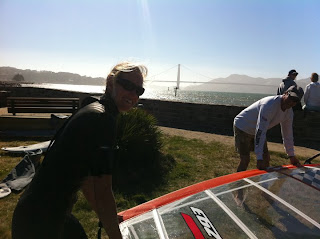
On July 17-24, more than 200 kids from 30 countries and 5 continents will descend on San Francisco Bay for the 2011 Bic Techno one-design World Championships, held at the St. Francis Yacht Club near the Golden Gate Bridge. The regatta is a big moment for the USA's windsurfing program, as it will provide a boost to our fledgling junior development program. The windy and rough conditions and dramatic scenery of San Francisco Bay will be an unparalleled experience for most sailors attending, including some of the USA's youth sailors from the East Coast.

Under the leadership of youth coach Britt Viehman, I assisted in coaching a Bic Techno clinic last week for American kids competing at the Worlds. Nine kids showed up, from both San Francisco and Florida. We had abilities ranging from fairly advanced to beginner, which is a typical skill range for American youth sailors. Each group of youth learned something new by participating in the training camp.


Sailors from Florida were wide-eyed after the first day of training in San Francisco. For many of them, it was the coldest and windiest conditions they had ever experienced. These sailors focused on planing technique up and downwind, tacks, jibes, and planing starts. A major factor contributing to the success of their training was developing confidence in the rough conditions. A few sailors spent time learning to make confident, fast runs upwind and downwind in a straight line, and develop sail handling techniques in windy conditions.

The local kids already had a good grip on the usual conditions, but what they didn't initially understand was the concept of sailing teamwork. For a few, it was the first time experiencing coaching on a schedule, two sessions a day, with a debrief after sailing. By the end of the camp, they were better about being on the water on time and keeping together in a group for drills to learn from each other. All the kids tuned up their equipment in the breeze, and learned more about San Francisco's famous currents - how to start in big current, and which side of the course would be favored by observing the action of the current in various stages of ebb and flood tides.

The only major flaw in the training camp is that it was too short as time and funding are limited at this point. The kids really needed a few weeks at this venue to further develop skills and confidence. However, the stoke was high as everyone is looking forward to returning to the City by the Bay and the Bic Techno Worlds.

(I wish I had more pictures for this blog, but we were really busy! Video coming soon.)

Wednesday, June 15, 2011

Weymouth: Culmination of a Season

The US Sailing Team is breathing a collective sigh of relief at the end of an incredibly tough week of regatta in Weymouth, UK. Sail for Gold, the sixth event on the World Cup regatta circuit, was also the first qualifier for the Olympic team (one of two events) and also a qualifier for the sole berth to compete in the Pre-Olympic Regatta, an Olympic test event held the first two weeks of August. I'm happy to say that my event went well and I finished as the top American RS:X woman and will compete in the Pre-Olympics.

Although I placed 19th in the Silver fleet, qualified for the Pre-Olympics and felt that in general, I sailed to the best of my ability, I am looking forward to better results in the future. A few factors affected my results, including technique in the windy, planing conditions that persisted throughout the week, and the high level of the fleet. With the exception of the first day, we had planing conditions for the remainder of the regatta in winds of 15-25+ knots! Although I had many days practicing in planing conditions and was able to sort out my technique, I still need more practice to apply the proper technique during racing. During an event, recently learned techniques are difficult to apply consistently, as I and other sailors often revert to the muscle memories we are most familiar with. Before the regatta, the wind was light for almost the entire week, as it was for most of my training in France. In France, I made major improvements to my sailing in marginal and non-planing conditions, which we saw almost none of during Sail for Gold. However, during the last few days of the event, I made improvements to my planing technique.

The overall level of the fleet was extremely high, as many countries are using Sail for Gold as an Olympic qualifier and peak event of the season. The windy conditions meant that the results were more mixed up than is usual, and many sailors had a truly difficult event. In the women's fleet, several teams as a whole had a better performance and a few had worse. This was exemplified by the New Zealand team, who had a few members in the Gold fleet, more than they usually have; and the Italian, British, Chinese, and Netherlands teams, who had less than average performances. The usual strong European competitors, the French and Polish teams, dominated the fleet.

Many US sailors had a tough time in Weymouth last week, and most of it was due to the windy conditions, the high level of the international fleets, and the focus on beating other team members in the first Olympic qualifier event. Closest home to my event in the RS:X men's fleet, Ben Barger placed behind Bob Willis, who has strong finishes in planing conditions. Both boys had a challenging time in the competitive fleet. Many US team members placed slightly lower than where they normally finish, including men's 470, Laser and Laser Radial. Although results may have been slightly "off," performances by the US team reflected their best efforts in the crazy conditions and top-level fleets. Achieving decent results despite our team's shortcomings is a great accomplishment for sailors as individuals. The "arms race" against fully-funded teams is difficult, and US sailors have many more issues to deal with than most of the top international sailors, all of which have an impact on our team's results. We all fight hard to sort out our funding, logistics, and other personal problems to do our best to prepare physically and mentally for competition. In the end, we are working with a management system that structurally is unable to support team goals as a whole, and too-new and unstable programs.
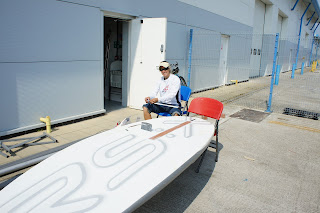
Fixing a gasket and fin before the event

Although we all have a challenging road ahead to stay abreast of the international fleet, we are all very positive and excited to improve and move forward. As the Olympics approach in one year's time, I'm really anxious to improve upon my training program even more. I'm happy with the progress I've made and am looking forward to getting the water time and coaching that I need. Next week I'm spending some time in San Francisco to get time in the extreme breeze, chop, and cold water, which I'm certain will advance me in Weymouth conditions. I'm really stoked about going to the Pre-Olympics and can't wait to get back to Weymouth to train.

Click here for results; click on a tab to view full results for each Olympic class boat or board.

Tuesday, May 31, 2011

French Training; Taking Care of Business

The pace of training and logistics accelerated during the past few weeks as I finished up a successful training camp in Brest, France, and shipped my rig back across the English Channel to Weymouth in preparation for Sail for Gold, our first Olympic Trials regatta. Training in Brest was highly productive and with the help of a very good French coach, filled in a number of gaps in my knowledge and gave me insight into another very successful sailing program.

The French have one of the most advanced sailing programs on the planet. In Brest, sailing is taught to most residents at a young age, and is integral to the culture, which could go as far back to over hundreds of years. On top of that, they are completely nuts about windsurfing, more so than any other country I've experienced. On any given windy day, you can see 50 recreational windsurfers bombing around, in Brest and its surrounding small villages. From this base, sailing is developed further at the club and national level under some very smart program directors and coaches (all with successful competitive careers). There are a good number of national training facilities, one of which is newly built in Brest. It's very difficult to rise to a level high enough to compete on the French National Team, and sailors competing at this level are extremely talented. Seeing the technically advanced level of their youth sailors gave me a very clear picture of the excellence of their training and coaching. The French have an advantage over almost every other country in the sport of sailing, and just keep pouring more resources into their program.

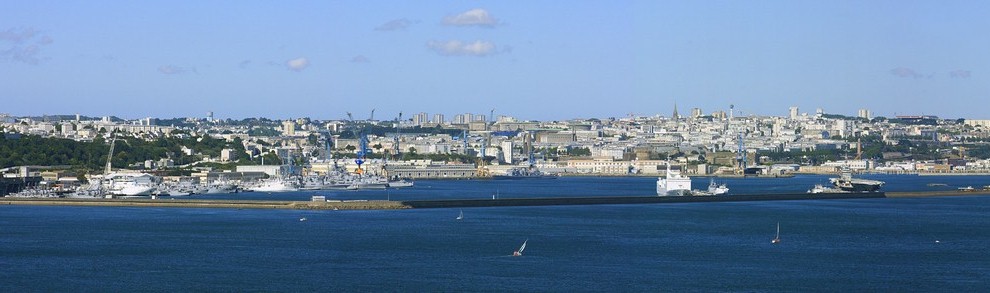
Bad picture of the Brest harbor stolen from the internet - I've lost my camera!

For all the advantages of the French system, they keep their methods and training guarded. Usually, outside sailors have to be careful not to overstep boundaries when training with their teams. We were not allowed to use their facility, and kept our equipment in our coach's shop. Training with the youth was acceptable as long as we didn't become too many, but I expect that it would be very difficult to secure an invitation to train with their national team. Other than those few rules, the sailors and coaches were happy to see us. It contrasted with my experience with the Polish, who are much more open about their training. However, as the Polish team becomes more prominent and professional with the addition of better resources, they are experiencing some growing pains and may become more closed. Both the French and Polish teams compete at a high level, and while I found the French may be better on a technical level, the Polish have a closer-knit team and support system, which is equally as important.

After sailing in Brest, I was ready for a short break before starting the final taper into the Weymouth Sail for Gold regatta. As with all breaks, time is filled with logistics and trying to accomplish all the things that need to be done off the water in a short time. The journey began with a ferry ride to Portsmouth, where my coach, Britt, and I stayed with a friend. We washed, unloaded and re-loaded equipment, and dropped the boat at the dealer's shop for a servicing. We inventoried items and went shopping, and tried to get some needed sleep. After a stop-and-go commute to Weymouth, (bank holidays!), we were ready to move in and get the equipment sorted.

All the time before Sail for Gold will be spent training lightly and acclimatizing to the conditions in Weymouth. So far we have seen a very windy week - almost 25 knots for days at a time. The weather is changing now, and we're not sure what will be in store for the regatta. I'm looking forward to the event, which should have a really tough fleet. Sail for Gold is the international peak event this season!

Wednesday, May 4, 2011

Acquiring Building Blocks: Coaching after Palma and the French Olympic Week

After my event in Palma turned out poorly, I finished up a little frustrated. However, one of the keys to getting quickly past frustration is analysis, checking over all the aspects of the regatta to figure out where the weaknesses are.


As I mentioned in the previous post, the major factor that affected my Palma event was recovery. After a really tough training camp in Cadiz, I didn’t get any physical therapy and remained pretty stressed for a few days afterwards with driving, ferries, and getting adjusted to routine in Palma. I didn’t want to go into the event tired, but I was distracted enough to affect my rest, and thus my focus was a little impaired. With this in mind, I set out to create a better training plan for myself, with speedy skill acquisition in mind.


As a science person, I find analysis to be an entertaining challenge. The trick is applying physical skills to meaningful data. My coach and I identified the skills that are most critical to having a good race, and assigned a numerical value to them representing my comparison to the skills of the fleet’s top sailors. We graphed the data simply to visually identify the skills I need to improve upon the most, in a few different conditions. I then created a table depicting every day I worked on each skill in each condition, starting upon my arrival in Hyeres, France, for the French Olympic Week. At the end of the season, I’ll know relatively how long it’s taking to develop a skill, or the number of days I was able to work on a particular item. All in all, a relatively simple way to keep track of learning.


Having a consistent checklist improved the quality of my training before the French Olympic Week. I made significant headway on a number of items in about a week of training before the event. Any new skill is a building block for each race, and the proper assembly of these blocks is what creates a good race and overall event. I can’t say that I put together a great result, but I certainly performed well for a definite number of skills, and sailed much better in this event than Palma.


The French Olympic Week saw mostly light and marginal conditions. We had only one fully-planing race on the first day. The committee did a good job of getting all the races in, and made some good calls on scheduling. Every day had a different start according to how the committee felt the wind would develop that day. In the qualifying series, we had three races on the day with better breeze, and one race on the lightest day. I found that I’m able to put together marginal-planing races together a bit better than light wind races, thanks to a lot of time training in Miami this winter.


In addition to the challenging conditions, the women’s fleet here was very big – 75 boards total, making two fleets. Many teams use this event as an Olympic qualifier, and it’s also a good venue for developmental sailors to compete. In short, this event had the best fleet quality of almost the entire 2012 quadrennium thus far (maybe with the exception of the 2010 Worlds in Denmark). The growing difficulty of the sport makes rapid learning a necessity, and my attempts to organize different systems for training will hopefully create a method that works well for me, and facilitates rapid assembly of skills critical for racing.


I’m now in Brest, France, beginning a training camp with local French sailors and youth men, and two sailor friends from Canada and Hungary. I’m confident that this will be a good week for learning. Afterwards, I go to Weymouth to begin training for the Sail for Gold Regatta, our first Olympic qualifier.

Monday, April 18, 2011

Trofeo Princesa Sofia 2011


Palma can be a difficult venue for most North American sailors, and some of the regatta results of the US Sailing Team Alphagraphics reflected this. Our team leader asked us for some factors that would have improved results, and for me there were three deciding factors.

The conditions at Palma are quite different from Florida, where most of us train in the winter and early spring months. Most, if not all, of the top finishers in Palma trained during the winter at the venue. If US sailors were to arrive for a three-week training block before the event, we wouldn’t be coming into the first European event “cold” and adjusting to being in Europe again.

In addition to earlier training, it is difficult this year to find training partners to tune up with. Having more support for the boards to find partners would effect this; our Olympic qualifying year makes it a more difficult time to try and fit into other teams’ schedules. This year, I need to spend more time at the Weymouth venue, taking time away from my usual training with the Polish youth team.

Finally, after an intense training camp in Cadiz, I didn’t recover in time for racing. Although I know and utilized a lot of endurance-athlete recovery tricks, the element missing was physical therapy. Not having therapy can interrupt my entire training schedule, as too much time is spent trying to recover instead of working out in the gym or on the water. Without physical recovery, mental recovery is more difficult as well. Recovery was the major factor that affected my results in Palma. As a high-level endurance sport, it’s silly not to have trainers here for boardsailors, and the entire team would benefit from adding physical therapy to more events.

The regatta was a great learning experience in that it was a lesson in what improper physical and mental preparation, and not enough time at the venue, can lead to. At this level of sailing, especially with the fleet’s ability growing stronger and stronger, smaller details become more important. In the results, lack of minor details was apparent in the performances of a few top sailors, who weren’t quite up to speed. As more resources are being applied to windsurfing, sailors are gaining more experience in the second quadrennium using the RS:X, and teams are gaining depth with growing youth programs, competition is at its pinnacle.

Apart from the sailing, I finally got to see some of Mallorca. Having the minivan enabled me to get away from the venue and touristy beaches. Tourism in Mallorca makes up about 60% of the GDP and drives most of business on the island. In the past 50 years, tourism has chiefly consisted of North Europeans coming down to get drunk and sunburned, and beach towns have aptly been described as “tourist ghettoes.” However, tourism marketing has shifted focus and the island is attracting crowds of cyclists and other types of “ecotourists.”

Non-beach tourism is focused around some picturesque mountain villages on the north side of the island, one of which we were able to visit on a free day. We cruised uphill in the van to Valldemosa, following packs of cyclists around hairpin turns at a snail’s pace. We also toured a monastery and enjoyed lunch at a port town. In short, we were perfect tourists for a day, stealing a rare moment away from the regatta venue.

I’m now in Hyeres, France, after a ferry trip and drive from Barcelona and have spent the week tuning up. I always enjoy the French Olympic Week and am looking forward to a fun event, starting this Easter Sunday.

Sunday, April 3, 2011

Princess Sofia Trophy, Palma de Mallorca, Spain

Polish youth coach Maciek Dziemanczuk and team

After a two-week training camp with the Polish team in El Puerto de Santa Maria, Spain (Cadiz area), I'm about to begin the World Cup event Princess Sofia Trophy in Mallorca, Spain.

Training in Cadiz and here in Mallorca before the event led to a new list of skills to develop. In the wavy conditions of the Mediterranean and before that, Bay of Cadiz, the skills I learned in Miami need to be refined and new ones learned.

Oftentimes in these older maritime regions, strong winds have character and are named. In South France, the 30-40 + knot offshore wind is famously known as "le Mistral," and in Cadiz a strong prevailing southwesterly is named "Levante." Levante made a showing for almost an entire week, and we trained in 30-knot breeze after a week of light wind. Although it wore out all the sailors, Levante created a great opportunity to find areas to strengthen for December's regatta in Perth, Australia, another notably windy venue. It was also a good warm-up for the Princess Sofia Trophy.

Fixing a broken batten
Team meeting

After just under a week's worth of training here in Palma, where I am being coached by Britt Viehman, it's evident that the conditions require techniques that are newer for me. We've developed a specific plan for each condition and the event will be a great training opportunity. This year before the Olympics, competition is at its best and toughest, and the large attendance of many top sailors will make the event challenging and exciting.

Palma cathedral, early morning by ferry

Saturday, March 26, 2011

Sailor Profile: Farrah Hall, Olympic Class Windsurfer


This video is an excerpt from Sperry Top-Sider's "Passion for the Sea" series, narrated by Gary Jobson. It was uploaded to YouTube by the new National Sailing Center and Hall of Fame in Annapolis, Maryland. The National Sailing Hall of Fame is honoring its first class of inductees on October 23, 2011.