Friday, April 11, 2014

Spring Training


I started out this season with two training camps, followed up by the second World Cup regatta of the year, the Princess Sofia Trophy.  This season has been difficult so far, as I have been sick a few times and am still searching for a good coaching situation.  My logistics have also been a little crazy with the winter weather delaying and canceling flights to Europe.  However I've made the best of it, and am still improving.
My first training session was in Marsala, Sicily, with one of the top Italian girls.  It was a great opportunity to work on planing technique, because we had some days with 25 knots and big waves.  We also took a sailing adventure - a windy four hour voyage to one of the islands off the Sicilian coast, Favignana.  We spent two nights there and managed to visit some of the island's beautiful places.


I then flew to Cadiz, Spain, where I spent two weeks training with the Polish National Team.  This session was an opportunity to get competitive and intense racing practice, and extensive physical training. I really enjoy training with the Polish team, as they are professional and focused, and give 100% in each session. 

After Cadiz, my next stop was in Palma de Mallorca, Spain, for the second World Cup regatta of 2014, the Princess Sofia Trophy.  A big, competitive fleet was at hand, including deep youth fleets of British, French, and Chinese sailors, and most of the experienced top women's competitors from Europe, Asia, and South America.  Each year, the fleet grows a bit, and the level is at its highest ever.  We had one fleet of over 50 women.

Palma is the trickiest venue of the circuit, and this regatta was no exception.  The newer format for World Cup events means three races a day regardless of conditions, and the ever-changing wind here meant we spent very long days on the water.  We experienced a wide variety of conditions from 5 knots to 25, and I felt comfortable in them, formed good strategies for each race, and knew what the wind was doing at any given moment.  However, I had a tough time executing some critical moments in each race, and consequently didn't have great results.  In a deep and large fleet, one or two mistakes in the beginning of a race are generally unforgivable.  I also came in overtrained, and the very long days contributed to getting sick again after the event.


Our next event, the Hyeres World Cup in the south of France, will again be very competitive.  I'm glad I had Palma to let me know what to expect for this next event in terms of fleet quality!  I'm looking forward to a few more days of rest and then preparation for Hyeres.

Thursday, February 6, 2014

Miami Madness

Last weekend, I finished up the most important event of the first half of 2014.  For me, the Miami Olympic Classes Regatta (OCR) had a massive buildup and anticlimactic end.  It was a struggle to get organized for the event, as Murphy's Law was in full effect when it came to my logistics.  This winter's bugbear, the Polar Vortex, also gave Miami some unusual and light conditions for the competition.

I came home in early January from Cadiz with a good plan for Miami.  I had a boat, coaching, and accommodation set up, and I was feeling confident with my training both on and off the water.  However, even the best laid plans aren't totally set in stone.  When I got home to Annapolis, my boat arrangement fell through due to an insurance concern.  Luckily, I was able to find a boat from the Severn Sailing Association that I could tow down to Miami!  On the day I was supposed to leave, however, I got really sick with flu-like symptoms.  Being stubborn, I naturally decided to start driving anyway.  It took me about 18 hours to get just to Georgia because I kept stopping every hour to sleep (normally, 18 hours would bring one to mid-south Florida).  After arriving, I found out my Spanish coach and training partner couldn't make it to Miami because they both got pneumonia and were in the hospital.  I had to scramble a bit to find a different coach.  To top off this excitement, the transmission in my minivan decided to suddenly quit, and I had to take it in for a complete and expensive rebuild. 

The Polar Vortex also played havoc with the regatta conditions for almost two weeks straight.  The weekend before the OCR, the boards competed in the "RS:X Nationals" warmup regatta.  We experienced very light and shifty westerly conditions, and I discovered a real strength.  We had long days on the water because we shared the course with 470 and 420 fleets, and the unstable wind created a lot of recalls and waiting.  Our races were also longer than usual, and at 35-45 minutes each, it meant a lot of pumping and physical effort.  Physically, I held up well and was able to recover between races and at the end of each day.  Now that my technique and fitness are working together, I was able to sail some excellent races focusing on tactics.  I finished third, very close to second, only due to a non-discardable black flag in part to race committee error.  


 Two starts at the RS:X Nationals
We experienced similar conditions for the first two days of the OCR, except the southerly directions were slightly less shifty.  I performed well tactically and physically during these days, and was quite happy with my consistent results.  After one day off due to thunderstorms and light wind, we were back in action with three more races in 8-12 knots.  We had about 7 starts for the three races because the wind shifted so many times!  I didn't have as good of a day, although I was doing some good things on the course.  The next day, of course, there was no wind again, so that left the fleet only with the medal race.  I was disappointed with some aspects of my performance in the medal race.  Although I had a good start and positioning on the fleet, I and two other girls were fouled at a tight windward mark rounding by a French sailor who had to double tack to get around it in the fairly strong current.  This put me back, and I made one more mistake on the second upwind that dropped me to second last, which was really disappointing as I had the chance to move up into 5th place.  I am happy to say I am back in my #1 spot on the team, and I've qualified to go to the Rio Olympic Test Event this summer.  Even though the OCR was a little crazy this year, it was a good test to evaluate my performance under outside pressure.  I have come away with many things to work on, both on the water and mentally.


My next steps are uncertain at this point, because I am in the process of finding a new training and coaching situation.  There is a lot of work to complete logistically, financially, and training-wise this month, but if there is anything January taught me, it's that I can handle whatever complications come my way and come out on top.  I'm confident I will create a strong plan over the next few weeks, and position myself where I need to be at the upcoming ISAF Worlds and Rio Olympic Test Event.

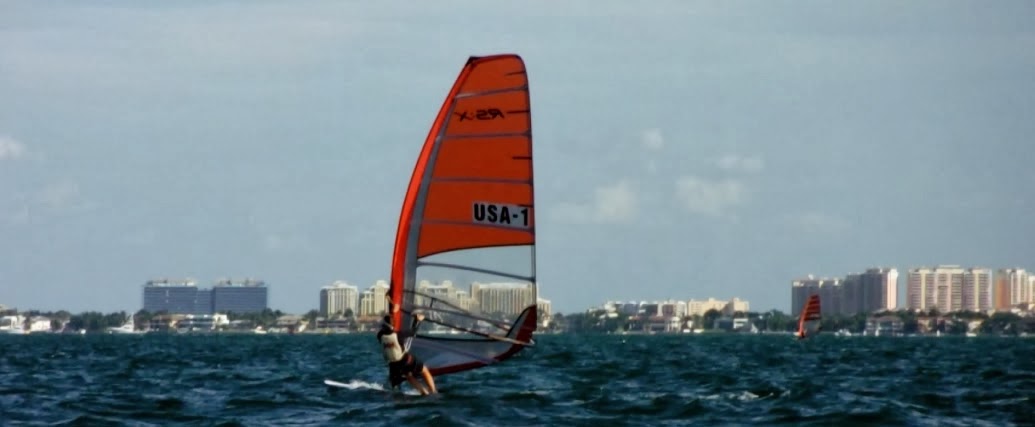
I realized after writing this that I don't have any pictures of myself at the OCR.  To make it up, here's a short clip of me sailing around with the city in the background...you can also laugh at my war paint at the end of the clip.  Eye black does work to absorb glare off the water.


Sunday, January 5, 2014

Holiday Training in Puerto de Santa Maria

My parents are becoming accustomed to my being away from home for Christmas.  Sometimes, the training schedule and budget prohibit my return home, and I'm "stranded" in places like Australia or Maui.  This season, I was fortunate enough to experience the holidays in Puerto de Santa Maria, Spain, for training and a regatta. 

Puerto is a well-attended venue for winter training by a number of Europeans. The weather is the best in continental Europe, and living is relatively cheap in an off-season beach town.  There is always a group of quality sailors and youth teams to train with, and I trained with folks from Spain, Sweden, France, Russia, the Ukraine, and Lithuania.  Conditions are challenging and can be just about anything, from flat water and light wind to giant ocean swell, strong current, and big breeze. 

My focus for this month in Spain was racing and synthesizing what I learned this fall in Santander and La Rochelle.  I also focused on physical training, as it's harder to make gains in this area during the main season in the spring and summer.  I had many very good days of practice racing in all types of condition. 

Mark rounding adjustments in big breeze
 At the end of my stay, the Federacion Andalucia de Vela held the New Year's Regatta.  I was happy with my performance during this event.  We had "unusual" weather:  a cold front with strong, gusty, and shifty wind; and two days with no wind altogether.  We raced only during the first two days, all of which were planing or marginally planing races.  The fleet was deep and aggressive, because we raced with many youth boys, and there were 30 sailors total, making it great practice for the Miami OCR, my next important event at the end of January.  I was happy with my speed and tactics, and the mistakes I made I felt were easily correctable.  With only six races, I finished tied for third out of the 23-board women's fleet.  I lost the tiebreaker, but was still happy with the finish.

  
Chasing one of the boys
  Not all of the month was spent training.  In Spain, getting things done is all about your connections.  I stayed with the cousin of a friend of a friend, and not only had a great living situation but also met a great new friend.  Even better, I got to help with her new puppy.  My best Spanish vocabulary is now dog commands.

I'm leaving for Miami in a few days for the most important event of the next 6 months.  The Miami OCR qualifies me for the 2014 US Sailing Team, the USA for the Pan American Games, and is a qualifier for the Olympic Test Event in Rio this July.  I feel prepared, and will be maintaining focus to make sure this event goes smoothly for me.  I'm looking forward to the first challenge of the new year.

 Nothing cuter or naughtier than a Christmas puppy!