Tuesday, May 31, 2011
French Training; Taking Care of Business
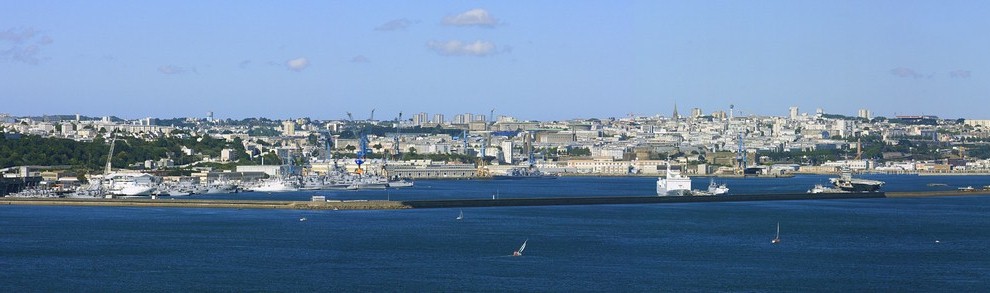
The French have one of the most advanced sailing programs on the planet. In Brest, sailing is taught to most residents at a young age, and is integral to the culture, which could go as far back to over hundreds of years. On top of that, they are completely nuts about windsurfing, more so than any other country I've experienced. On any given windy day, you can see 50 recreational windsurfers bombing around, in Brest and its surrounding small villages. From this base, sailing is developed further at the club and national level under some very smart program directors and coaches (all with successful competitive careers). There are a good number of national training facilities, one of which is newly built in Brest. It's very difficult to rise to a level high enough to compete on the French National Team, and sailors competing at this level are extremely talented. Seeing the technically advanced level of their youth sailors gave me a very clear picture of the excellence of their training and coaching. The French have an advantage over almost every other country in the sport of sailing, and just keep pouring more resources into their program.
For all the advantages of the French system, they keep their methods and training guarded. Usually, outside sailors have to be careful not to overstep boundaries when training with their teams. We were not allowed to use their facility, and kept our equipment in our coach's shop. Training with the youth was acceptable as long as we didn't become too many, but I expect that it would be very difficult to secure an invitation to train with their national team. Other than those few rules, the sailors and coaches were happy to see us. It contrasted with my experience with the Polish, who are much more open about their training. However, as the Polish team becomes more prominent and professional with the addition of better resources, they are experiencing some growing pains and may become more closed. Both the French and Polish teams compete at a high level, and while I found the French may be better on a technical level, the Polish have a closer-knit team and support system, which is equally as important.
After sailing in Brest, I was ready for a short break before starting the final taper into the Weymouth Sail for Gold regatta. As with all breaks, time is filled with logistics and trying to accomplish all the things that need to be done off the water in a short time. The journey began with a ferry ride to Portsmouth, where my coach, Britt, and I stayed with a friend. We washed, unloaded and re-loaded equipment, and dropped the boat at the dealer's shop for a servicing. We inventoried items and went shopping, and tried to get some needed sleep. After a stop-and-go commute to Weymouth, (bank holidays!), we were ready to move in and get the equipment sorted.
All the time before Sail for Gold will be spent training lightly and acclimatizing to the conditions in Weymouth. So far we have seen a very windy week - almost 25 knots for days at a time. The weather is changing now, and we're not sure what will be in store for the regatta. I'm looking forward to the event, which should have a really tough fleet. Sail for Gold is the international peak event this season!
Wednesday, May 4, 2011
Acquiring Building Blocks: Coaching after Palma and the French Olympic Week
After my event in Palma turned out poorly, I finished up a little frustrated. However, one of the keys to getting quickly past frustration is analysis, checking over all the aspects of the regatta to figure out where the weaknesses are.
As I mentioned in the previous post, the major factor that affected my Palma event was recovery. After a really tough training camp in Cadiz, I didn’t get any physical therapy and remained pretty stressed for a few days afterwards with driving, ferries, and getting adjusted to routine in Palma. I didn’t want to go into the event tired, but I was distracted enough to affect my rest, and thus my focus was a little impaired. With this in mind, I set out to create a better training plan for myself, with speedy skill acquisition in mind.
As a science person, I find analysis to be an entertaining challenge. The trick is applying physical skills to meaningful data. My coach and I identified the skills that are most critical to having a good race, and assigned a numerical value to them representing my comparison to the skills of the fleet’s top sailors. We graphed the data simply to visually identify the skills I need to improve upon the most, in a few different conditions. I then created a table depicting every day I worked on each skill in each condition, starting upon my arrival in Hyeres, France, for the French Olympic Week. At the end of the season, I’ll know relatively how long it’s taking to develop a skill, or the number of days I was able to work on a particular item. All in all, a relatively simple way to keep track of learning.
Having a consistent checklist improved the quality of my training before the French Olympic Week. I made significant headway on a number of items in about a week of training before the event. Any new skill is a building block for each race, and the proper assembly of these blocks is what creates a good race and overall event. I can’t say that I put together a great result, but I certainly performed well for a definite number of skills, and sailed much better in this event than Palma.
The French Olympic Week saw mostly light and marginal conditions. We had only one fully-planing race on the first day. The committee did a good job of getting all the races in, and made some good calls on scheduling. Every day had a different start according to how the committee felt the wind would develop that day. In the qualifying series, we had three races on the day with better breeze, and one race on the lightest day. I found that I’m able to put together marginal-planing races together a bit better than light wind races, thanks to a lot of time training in Miami this winter.
In addition to the challenging conditions, the women’s fleet here was very big – 75 boards total, making two fleets. Many teams use this event as an Olympic qualifier, and it’s also a good venue for developmental sailors to compete. In short, this event had the best fleet quality of almost the entire 2012 quadrennium thus far (maybe with the exception of the 2010 Worlds in Denmark). The growing difficulty of the sport makes rapid learning a necessity, and my attempts to organize different systems for training will hopefully create a method that works well for me, and facilitates rapid assembly of skills critical for racing.
I’m now in Brest, France, beginning a training camp with local French sailors and youth men, and two sailor friends from Canada and Hungary. I’m confident that this will be a good week for learning. Afterwards, I go to Weymouth to begin training for the Sail for Gold Regatta, our first Olympic qualifier.
Monday, April 18, 2011
Trofeo Princesa Sofia 2011
Palma can be a difficult venue for most North American sailors, and some of the regatta results of the US Sailing Team Alphagraphics reflected this. Our team leader asked us for some factors that would have improved results, and for me there were three deciding factors.
The conditions at Palma are quite different from Florida, where most of us train in the winter and early spring months. Most, if not all, of the top finishers in Palma trained during the winter at the venue. If US sailors were to arrive for a three-week training block before the event, we wouldn’t be coming into the first European event “cold” and adjusting to being in Europe again.
In addition to earlier training, it is difficult this year to find training partners to tune up with. Having more support for the boards to find partners would effect this; our Olympic qualifying year makes it a more difficult time to try and fit into other teams’ schedules. This year, I need to spend more time at the Weymouth venue, taking time away from my usual training with the Polish youth team.
Finally, after an intense training camp in Cadiz, I didn’t recover in time for racing. Although I know and utilized a lot of endurance-athlete recovery tricks, the element missing was physical therapy. Not having therapy can interrupt my entire training schedule, as too much time is spent trying to recover instead of working out in the gym or on the water. Without physical recovery, mental recovery is more difficult as well. Recovery was the major factor that affected my results in Palma. As a high-level endurance sport, it’s silly not to have trainers here for boardsailors, and the entire team would benefit from adding physical therapy to more events.
The regatta was a great learning experience in that it was a lesson in what improper physical and mental preparation, and not enough time at the venue, can lead to. At this level of sailing, especially with the fleet’s ability growing stronger and stronger, smaller details become more important. In the results, lack of minor details was apparent in the performances of a few top sailors, who weren’t quite up to speed. As more resources are being applied to windsurfing, sailors are gaining more experience in the second quadrennium using the RS:X, and teams are gaining depth with growing youth programs, competition is at its pinnacle.
Apart from the sailing, I finally got to see some of Mallorca. Having the minivan enabled me to get away from the venue and touristy beaches. Tourism in Mallorca makes up about 60% of the GDP and drives most of business on the island. In the past 50 years, tourism has chiefly consisted of North Europeans coming down to get drunk and sunburned, and beach towns have aptly been described as “tourist ghettoes.” However, tourism marketing has shifted focus and the island is attracting crowds of cyclists and other types of “ecotourists.”
Non-beach tourism is focused around some picturesque mountain villages on the north side of the island, one of which we were able to visit on a free day. We cruised uphill in the van to Valldemosa, following packs of cyclists around hairpin turns at a snail’s pace. We also toured a monastery and enjoyed lunch at a port town. In short, we were perfect tourists for a day, stealing a rare moment away from the regatta venue.
I’m now in Hyeres, France, after a ferry trip and drive from Barcelona and have spent the week tuning up. I always enjoy the French Olympic Week and am looking forward to a fun event, starting this Easter Sunday.
Sunday, April 3, 2011
Princess Sofia Trophy, Palma de Mallorca, Spain
After a two-week training camp with the Polish team in El Puerto de Santa Maria, Spain (Cadiz area), I'm about to begin the World Cup event Princess Sofia Trophy in Mallorca, Spain.
Training in Cadiz and here in Mallorca before the event led to a new list of skills to develop. In the wavy conditions of the Mediterranean and before that, Bay of Cadiz, the skills I learned in Miami need to be refined and new ones learned.
Oftentimes in these older maritime regions, strong winds have character and are named. In South France, the 30-40 + knot offshore wind is famously known as "le Mistral," and in Cadiz a strong prevailing southwesterly is named "Levante." Levante made a showing for almost an entire week, and we trained in 30-knot breeze after a week of light wind. Although it wore out all the sailors, Levante created a great opportunity to find areas to strengthen for December's regatta in Perth, Australia, another notably windy venue. It was also a good warm-up for the Princess Sofia Trophy.
After just under a week's worth of training here in Palma, where I am being coached by Britt Viehman, it's evident that the conditions require techniques that are newer for me. We've developed a specific plan for each condition and the event will be a great training opportunity. This year before the Olympics, competition is at its best and toughest, and the large attendance of many top sailors will make the event challenging and exciting.
Saturday, March 26, 2011
Sailor Profile: Farrah Hall, Olympic Class Windsurfer
This video is an excerpt from Sperry Top-Sider's "Passion for the Sea" series, narrated by Gary Jobson. It was uploaded to YouTube by the new National Sailing Center and Hall of Fame in Annapolis, Maryland. The National Sailing Hall of Fame is honoring its first class of inductees on October 23, 2011.
Saturday, March 19, 2011
Going fast downwind in 25 knots, Cadiz, Spain
At a training camp with the Polish youth team from Sopot. We've seen almost every kind of condition this week, from this windy extreme to very light wind and sunny weather.
Sunday, March 13, 2011
Time zones, logistics, budgets, and Garmin GPS
Life would be a lot easier if someone took over the responsibility of planning my campaign, and all I had to worry about was training and racing. However, like the majority of Olympic hopefuls who don't have a team of support personnel, planning, logistics, and budget management falls squarely onto my shoulders.
Without missing a beat, the day after the Rolex Miami OCR, I attended a USSTAG meeting to learn about what they had planned for us regarding training camps, logistics, and coaching. As is the norm, the boards are the least-funded Olympic class, and only $10,000 is allocated for our coaching budget, a total of two regattas for both men and women RS:X sailors. (All the other boat classes have coaches for most of the World Cup events.) With this shortcoming in mind, I set to work raising money for my own program.
Most Olympic-class sailors are well-aware that full-time coaching is an absolute necessity. Without constant feedback, analysis, and support on the water, jumping into Olympic-level training and competition is frustrating and difficult. All the top teams have a fully-planned schedule with a national coach, and most sailors wouldn't think of heading out to a serious training session without this support. In order to compete with the best, my resources must be at the same level, or better, in an innovative way. Both coaching and the logistics of including a coach are expensive and time-consuming, and I can't say that I've exactly found the most innovative solution for myself, but that the resources have come slowly together over the past few years and I'm now in a position to have a coaching program for the spring World Cup regattas.
After the Miami OCR, I spent the entire month of February pushing single-mindedly to get funding. I've applied for a few more grants, and spent a lot of time following up with prospective donors. In some ways, I'm "counting chickens before they're hatched" in that I don't have my full budget, but I'm expecting my efforts to pay off, and put me in the best position possible to make good results for the USA at the early World Cup events, our first Olympic Trials event, and score the boards more funding for the 2016 quadrennium.
Apart from fund raising, my next challenge was organizing a coach boat, transport, housing, and other necessities for three months in Europe. Appraising my budget, the first glaring expense was coach boat charters - almost $30,000 a year to charter a boat at each event, plus a major hassle sourcing these boats. Through creative financing / deficit spending, I've been able to acquire a coach boat for this season. Given the fact that a boat costs much less than $30,000, and finding boats can be stressful, buying a boat was almost a no-brainer, although very difficult, decision. Being a frugal person by nature, I'm tortured by expensive decisions!
I was very pressed for time in February from all the fund raising, some training in St. Petersburg with our youth team, and getting very sick for a week. This made it necessary to acquire the boat sight-unseen in the UK, and prepare my van, also in the UK, from afar. This required some acrobatics. Luckily, a very generous friend from Hayling Island, UK, picked up my van from Weymouth, had the oil changed, and installed a tow bar. The friend also inspected a boat I found online, approved it, delivered it, and found a really nice trailer and covers for it. I'm really excited about my boat, which is a Solent RIB, made by a local company for the south coast of the UK. Not to mention, it has a nice, efficient engine, and very pretty colors!
After picking up the boat and running around for a few days at Hayling Island to insure and register it, I was ready for the road. One ferry ride and 1,500 miles later, van, boat, and I were safely at our next destination in Cadiz, Spain, where I will be training for the next two weeks with a few teams from Poland. Driving 1,500 miles in the US is relatively easy on our interstate system, but over here, the same distance takes almost twice as long. Slower speeds, toll highways, winding roads and massive hills make driving much more difficult (and expensive!). Luckily, I was still adjusting to the time difference, so it was easier to stay awake at night. Adding to the ordeal was my GPS, which took me on a few boondoggles, and had me in hysterics with its arrogant directives and mispronunciations of place names. A few lessons my dad taught me about vehicles came to good use on this trip: drive slowly and gently, check the oil and fluids at every stop, and check over the rig carefully. Although I was obsessively careful, my hard-working, 14-year-old minivan suffered; the transmission is definitely on its way out and it's riding pretty rough. With a little TLC it should at least live through the season. It's survived multiple trips across, up, and down both coasts of the USA, and laps around North Europe...it can't quit on me now!
Although I had a rough drive, the Polish drove almost twice as far and arrived in Cadiz, in the middle of the night, like the walking dead. During that night, a huge party (for Carnaval) raged through the marina and a few drunken revelers decided it would be a good idea to take bikes from their trailer and ride them around. Luckily, the police were on hand to apprehend the thieves and the bicycles!
I'm really excited to be here in a very beautiful town with an impressive sailing facility, training with an excellent team. I'm working with one of the coaches from the Sopot Sailing Club, and some fast younger sailors. Joining us will be some of the women on the Polish National Team and their coach. I'm looking forward to some pretty intense on-the-water sessions and being around a great group of people I consider to be my teammates.


